
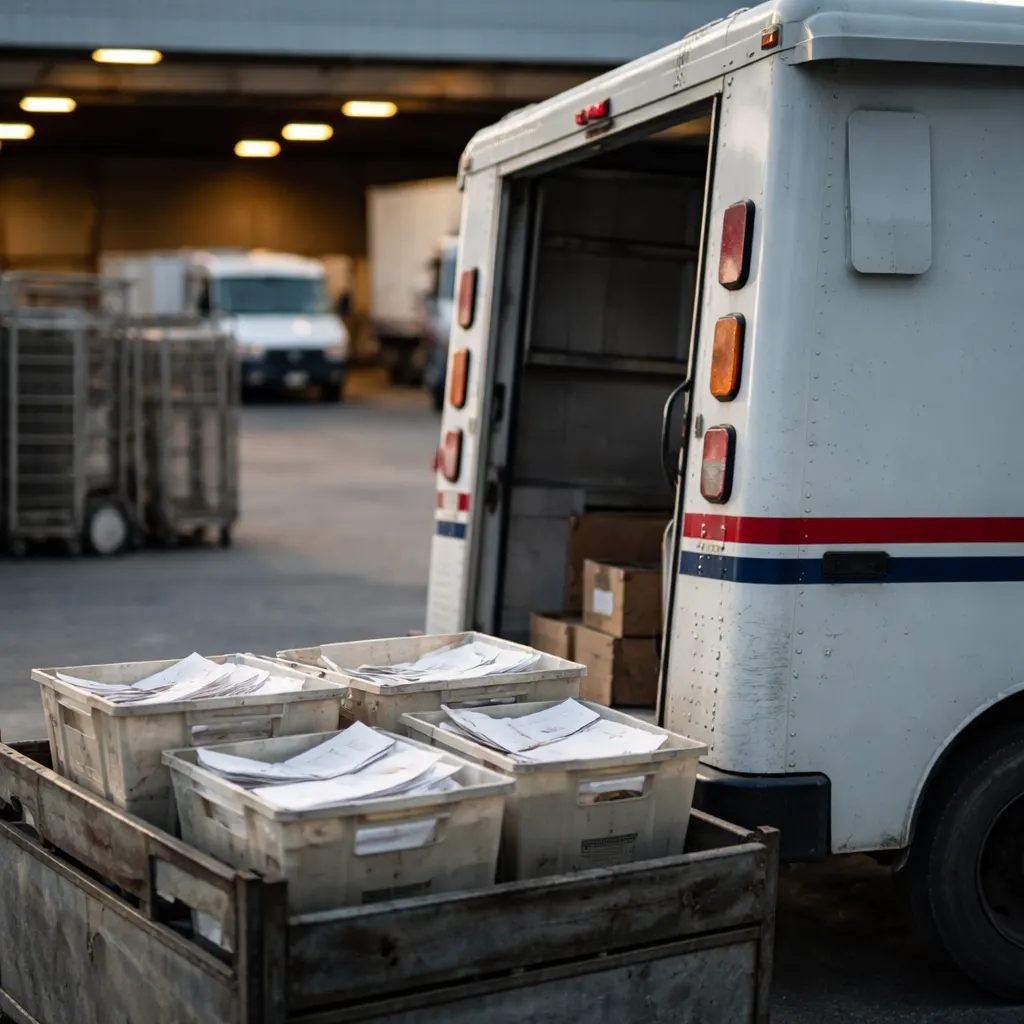
The U.S. Postal Service has bought itself a few more years before running out of cash, but Postmaster General David Steiner told a Senate committee Wednesday that the agency will hit a financial breaking point between 2031 and late 2034 without major reforms. Testifying before the Committee on Homeland Security and Government Affairs on June 25, 2026, Steiner warned that the agency is "borrowing from our employees' retirement funds to continue operations" and presented Congress with a stark choice: let the Postal Service operate like a private company, free of government mandates, or provide federal subsidies to cover the cost of universal mail delivery.
The numbers paint a grim picture. The Postal Service is carrying nearly $31 billion in debt while holding just $8.9 billion in unrestricted cash. Mail volume has dropped by more than half since peaking in 2000, yet the agency still serves 1 million new addresses each year and maintains a workforce roughly the same size as in the 1970s. At the current First-Class stamp price of 78 cents, that lost volume represents $81 billion in potential revenue. Over the past five fiscal years, the Postal Service has racked up $9.7 billion in controllable losses, with about 70% of its net loss coming from expenses it can't control. The agency avoided a shutdown in 2027 by deferring payments to employee retirement funds and using other accounting maneuvers, but those stopgap measures only delay the inevitable cash crunch.
"The bottom line is that we are out of cash," Steiner said in his prepared remarks. "Our financial situation is dire and requires prompt consideration of legislation to ensure continuation of operations." The report notes that the 2022 Postal Service Reform Act addressed some problems—ending burdensome retiree healthcare prefunding requirements and integrating postal retiree healthcare with Medicare—but didn't solve the fundamental mismatch between the agency's universal service mission and its shrinking revenue base. Steiner told lawmakers that subsidizing universal mail delivery would not only keep the Postal Service alive but also support a $2 trillion mailing industry that depends on it.
The crisis stems from a collision between declining demand and rising obligations. While Americans send far fewer letters than they did two decades ago, federal law still requires the Postal Service to deliver mail six days a week to every address in the country, no matter how remote or unprofitable. Congress has repeatedly blocked modernization efforts like consolidating distribution centers, lowering service standards, and raising prices more aggressively. Steiner pointed to recent interference from the Postal Regulatory Commission, which limited price increases to once a year—a move he said will cost the agency $700 million annually. He also criticized federal restrictions that prevent the Postal Service from managing workers' compensation claims efficiently or shipping alcohol like private competitors can. The agency has tried to stop the bleeding with an 8% parcel surcharge, a renegotiated Amazon contract at 80% of previous volume, a new last-mile delivery deal with DHL eCommerce, and a proposed stamp price hike to 82 cents, but none of it's enough to close the gap.
Steiner's most immediate recommendation is to raise the Postal Service's borrowing authority from $15 billion to somewhere between $30 billion and $40 billion, which would give management breathing room to tackle deeper structural problems. Other options on the table include cutting delivery days, closing money-losing post offices, substantially raising stamp prices, investing pension funds, and revising how the agency calculates its Civil Service Retirement System obligations. Without action, the clock is ticking. Once retiree health benefits premium payments come due and the health benefits fund runs dry in the next five to eight years, the nation's mail operator will be forced to shut down—and with it, a critical piece of infrastructure that millions of Americans and businesses still depend on every day.