
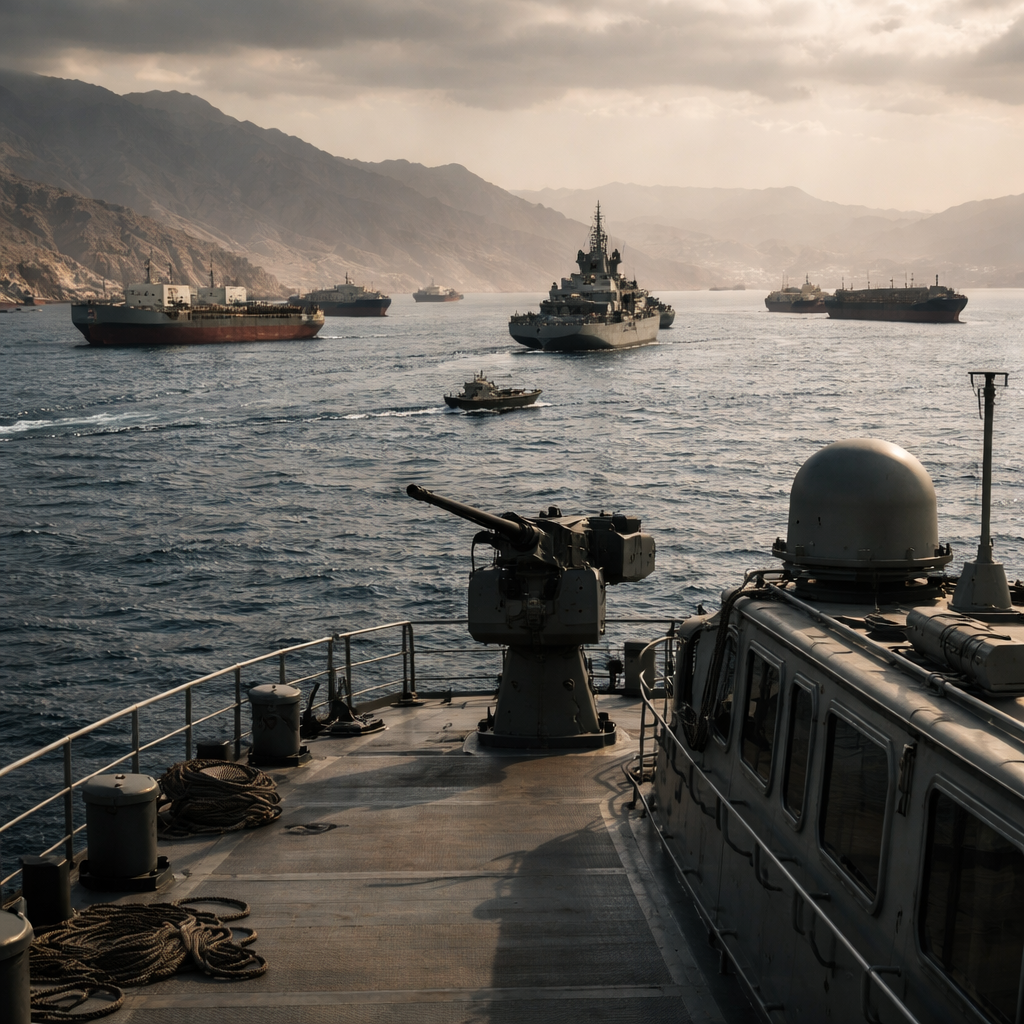
Iran has effectively shut down the Strait of Hormuz, reducing daily vessel movements to single digits through a waterway that normally handles more than a hundred ships, according to a report published June 9, 2026, by the Hoover Institution. Written by Vivek Lall, Chief Executive of General Atomics Global Corporation and Distinguished Visiting Fellow at Hoover, the analysis warns that Iran's successful closure of a chokepoint carrying twenty percent of global seaborne oil trade demonstrates a dangerous new model of maritime coercion that could spread to the South China Sea and other contested waterways. The strait remains functionally closed months after the February 28 U.S.-Israeli airstrikes that killed Supreme Leader Ali Khamenei, despite a Pakistan-brokered ceasefire in early April.
The report describes a maritime standoff with severe economic consequences. Hundreds of ships remain stranded in the Persian Gulf as of May 11, 2026. Iran has published naval maps suggesting mined waters, designated new shipping lanes closer to its coastline, and reportedly demanded transit fees exceeding one million dollars per vessel. Insurance premiums for Hormuz transit surged before any ships were struck, and war risk rates eventually became prohibitive, forcing shipping firms to suspend operations entirely. Oil prices rose past one hundred dollars a barrel. Gulf fertilizer exports, which account for roughly thirty percent of internationally traded supply, were disrupted. U.S. efforts to escort stranded vessels have produced only limited relief amid renewed military incidents near the strait.
The report quotes the CEO of Abu Dhabi's national oil company stating bluntly: "The Strait of Hormuz is not open. Access is being restricted, conditioned and controlled. That is not freedom of navigation. That is coercion." Lall writes that Iran accomplished the shutdown using mines costing a few thousand dollars apiece and shore-launched anti-ship missiles, demonstrating that "a determined state can shut down a critical artery of global commerce, impose conditions on its reopening, and extract concessions without ever winning a naval battle." The report emphasizes that the target is no longer the ship itself but "the commercial ecosystem that makes trade possible: the insurance underwriting, the port schedules, and the expectations of predictability on which supply chains depend."
The analysis argues that Iran's tactics expose fatal weaknesses in America's naval strategy and could provide a blueprint for China. The Fifth Fleet couldn't prevent Hormuz from closing, and the broader Navy can't simultaneously sustain commitments across the Gulf, Western Pacific, and Indian Ocean while the shipbuilding pipeline fails to produce hulls fast enough to replace aging vessels. Each new guided-missile destroyer costs north of two billion dollars, while adversaries achieve strategic effects with cheap mines and missiles. Lall contends that "presence alone no longer works" and calls for persistent autonomous maritime awareness through long-endurance unmanned aerial systems, unmanned surface vessels, and autonomous underwater platforms that can detect mine-laying activity manned patrols routinely miss. The report also recommends hardening critical energy infrastructure in the Gulf, building rapid repair capability, and expanding strategic reserves to reduce the coercive leverage of any single chokepoint.
The report warns that if Iran's closure of Hormuz succeeds in extracting political concessions, the precedent will spread to every contested waterway where a state calculates that closing a chokepoint is cheaper than confronting a navy. The fundamental question, according to Lall, is "whether the global maritime order will continue to function on the principle that international straits remain open to all nations under international law, or whether passage will increasingly depend on permission, payment, and political alignment." He notes that transit passage through straits used for international navigation is widely understood as customary international law, making Iran's actions a direct challenge to the legal foundations of the system underpinning global trade since 1945. The report concludes that democracies have the tools and partnerships to prevent this outcome but have lacked the discipline to build the necessary architecture before crisis forces improvisation. "Hormuz has delivered that lesson in the most expensive way possible," Lall writes. "The next exam will not come with a six-week warning."