
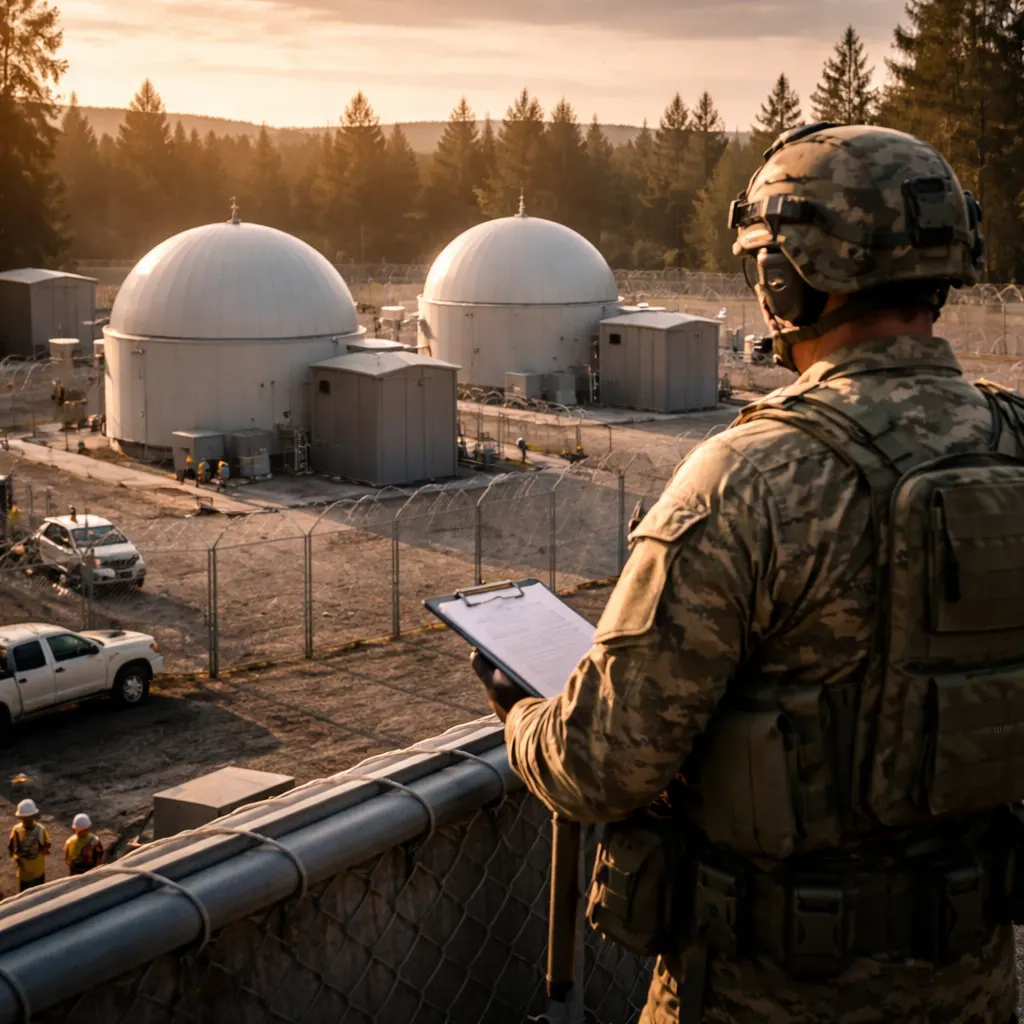
The U.S. Army has selected five companies to deploy nuclear microreactors at military installations nationwide, marking a major commitment that could provide the struggling advanced nuclear industry with its first large-scale customer. The service announced Wednesday that the reactors, ranging from 1 megawatt to 20 megawatts each, will supply resilient power for critical infrastructure while staying connected to the civilian grid under normal conditions. The effort aims to prove out designs that companies can eventually sell commercially, not just serve as a technology demonstration.
Under the Army's Janus program, Antares Nuclear and Radiant Industries will construct three reactors each at Fort Bragg, North Carolina, and Fort Benning, Georgia, respectively. BWX Technologies, General Atomics Electromagnetic Systems, and Westinghouse Government Services each secured contracts for one reactor at Fort Campbell, Kentucky; Fort Hood, Texas; and Fort Drum, New York. The investment framework combines roughly $2.2 billion in federal funding from fiscal years 2027 through 2031 with private capital from each vendor expected to cover the majority of total project costs, which officials said will reach billions of dollars overall. The Defense Innovation Unit is using fixed-price, milestone-based payments modeled partly on NASA's partnership with SpaceX, covering engineering, regulatory work, construction, and the first year of operation. After that initial period, projects are expected to transition to Army power purchase agreements or other long-term arrangements. The Army is targeting at least one operational reactor by September 30, 2028, with the program aiming to deliver more than 20 reactors across various sites within five years.
Jeff Waksman, principal deputy assistant secretary of the Army for installations, energy and environment, told reporters the goal is "to have companies that can stand up on their own afterwards without government subsidies." The Army framed the initiative as more than a proof of concept, stating in its announcement that "the Janus Program will be a complete success when and only when we have assisted multiple nuclear companies in developing truly reliable and affordable nuclear microreactors which they can sell to other buyers beyond just the military." The service said collaboration with utilities will be essential to its nuclear strategy and invited them to work with the government on future utility-scale, grid-facing generation located on Army installations.
The program addresses a persistent challenge for advanced nuclear developers: securing committed early customers willing to absorb some of the financial and technical risks of first-of-a-kind deployments. By providing milestone-based federal funding rather than simply purchasing reactors outright, the Army is helping companies overcome the additional costs of developing and deploying early commercial units without structuring the arrangement as conventional cost-sharing. All five designs will use encapsulated nuclear fuel, likely tristructural isotropic fuel because it's already qualified and in production, but the reactors will require high-assay low-enriched uranium that the Department of Energy is expected to supply initially by downblending existing stockpiles. Fueling more than 20 units could strain limited U.S. supplies, Waksman noted, even as DOE has committed about $2.7 billion to expand enrichment capacity. The units will operate under an Army regulatory process rather than Nuclear Regulatory Commission oversight, though officials said they're working closely with DOE and NRC to align standards so companies can more easily pursue licenses for broader commercial deployment.
Success in domestic deployment is intended to pave the way for potential future use in remote or austere locations such as Alaska or U.S. Pacific island outposts. The reactors are designed primarily around installation resilience, staying connected to the grid but providing backup power if service is disrupted, and as "inherently safe" systems that shut down on their own without relying on external power or diesel generators. Under a planned Pentagon-wide waste agreement the Army is negotiating with the Department of Energy, all spent fuel and other radiological material must be removed from a site within two years of a reactor shutting down, ensuring no long-term nuclear waste remains on installations. If the companies can deliver reliable, affordable units over the coming years, they'll have proven both their technology and a business model that doesn't depend on government subsidies—exactly the validation the advanced nuclear industry has struggled to secure.